Modern Hybrids make use of efficiency-improving technologies such as regenerative brakes which convert the vehicle's kinetic energy to electric energy to charge the battery. Some varieties of Hybrids use their internal combustion engine to generate electricity by spinning an electrical generator to either recharge their batteries or to directly power the electric drive motors; this combination is known as a motor–generator. Many HEVs reduce idle emissions by shutting down the ICE at idle and restarting it when needed; this is known as a start-stop system.
A hybrid-electric produces less emissions from its ICE than a comparably sized gasoline car, since an HEV's gasoline engine is usually smaller than a comparably sized, pure gasoline-burning, vehicle and if not used to directly drive the car, can be geared to run at maximum efficiency, further improving fuel economy. (Natural gas and propane fuels produce fewer emissions.)
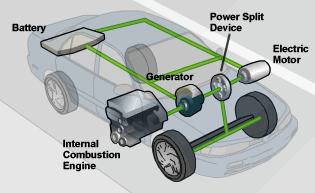

I love the diagram. It's user friendly and well-positioned. I was able to read and glance at the diagram to understand the workings of the HEV.
ReplyDeleteNice explanation. Easy to follow for someone who's not too knowledgeable about cars like myself.
ReplyDeleteThis comment has been removed by the author.
ReplyDeleteVery interesting. What an amazing invention!
ReplyDelete